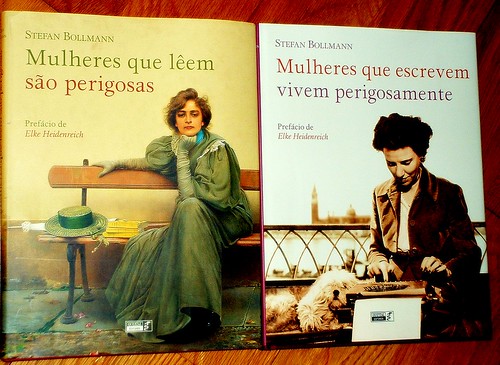
I am not quite a literature junkie. I’ll read it for school, and maybe even pick up a recommended novel, but literature is a tricky thing to read, especially when you want to read about girls.
I usually read regular old not-literature novels—and in terms of female characters, I’m a lot happier with the spread I read. I get girls who are fighters and diplomats and complex and dynamic in positions of respect and power.
I struggle with literature because more often than not, this is not the case.
As I just said, I’m not a literature junkie, but I’ve done a little research and dug out a few titles to support my point. They're either ones I've either read or recognize—and I am by no means an expert, which means you are welcome to challenge me. But in what I've read, I notice a few things.
 |
| Flickr Credit: r8r |
Women face SO MUCH OPPRESION (socially… economically… politically… religiously…)
The Awakening—Edna Pontellier cannot self-actualize or be with the man she loves because societal standards say she must stay at home and be there for her husband and kids.
A Handmaid’s Tale—Offred is the possession of others and is basically an object kept for her reproduction value alone.
Pride and Prejudice—some idiot based his financial security and retirement on having a son, which didn’t happen, which means that in order to guarantee future security the Bennett sisters must marry because they are inadequate economic heirs.
The Scarlet Letter—Hester is publicly humiliated and despised because of her adultery and her baby daddy’s anonymity, and faces the threat of having her daughter taken away from her, and is only ever remembered as an adulterous instead of a really good seamstress and decent human being.
Jane Eyre—Jane longs for liberty and morality at the same time but by nature of those things the way she wants her life to work out doesn’t always; also, many people like her aunt and school and boyfriends try to take away her liberty, which is also a problem.
(Okay, I still love
Jane Eyre, and it’s a decent struggle. But if we look at the group, it’s still a pattern.)
Or their own story is overshadowed
To Kill a Mockingbird—to be fair, there are some other ladies in this book, but the real story is about Atticus and Tom Robinson and Boo Radley; Scout isn’t exactly her own protagonist.
Women sometimes don’t even feature in literature, or their presence wouldn’t pass the Bechdel test.
Lord of the Rings—Gladriel, Arwen, and Éowyn are the main female characters (not that Lobelia Sackville-Baggins doesn’t count) and none of them ever meet; it’s a story almost exclusively about guys.
Lord of the Flies—a group of boys on an island; no girls exist.
Of Mice and Men—if I recall correctly, there is only one female character, Curley’s wife (she doesn’t even get a name), who “exists as a symbol of temptation to Lennie.” She dies.
The Name of the Rose—takes place in a medieval monastery, the only girl is also nameless and the love interest of the narrator. In the movie the cracks against women made me want to punch the screen. Ugh.
Even if they do pass the Bechdel test it doesn’t indicate that the women are particularly well-written or complex.
Catcher in the Rye—there’s a conversation between Phoebe and her mom that allows this book to pass the test; all the same, the fact that it’s the only example of female bonding (even though Holden goes to a boy’s school and spends a lot of time alone, blah, blah, blah) doesn’t exactly redeem the story.
The Invisible Man—there were a few women in the story, I guess, it’s just that they didn’t get much attention. Just homemakers, proprietors of rooms to rent, plot devices. There’s nothing memorable about them.
I haven’t read any of the following books, nor looked them up—but I can tell you what I know of their reputations.
Moby-Dick—the actions of a vengeful [male] captain (Quigley? I can’t remember if that’s from Sherman’s Lagoon or not) result in a dead white [male] whale .
Don Quixote—a would-be [male] knight and his short and useful [male] friend go about trying to be chivalrous in Spain.
Frankenstein—a [male] doctor creates a [male] monster with his [male] henchman, Fritz or Igor or something. BUT I do recall that Dr. Frankenstein has a fiancé, who I think dies.
The Strange Case of Dr. Jekyll and Mr. Hyde—I’ve seen the musical, and there are like three girls (not counting other prostitutes) that don’t pass the Bechdel test (I think?) BUT in terms of what I know about the book another [male] doctor tries to mess with the forces of good and evil and makes another [male] monster that kills many people. Most of them are male.
The Old Man and the Sea—well, there’s a male old man. I seem to recall he gets baptized or is a Christ figure, some kind of religious significance. And possibly there is a male boy.
~*~*~
DO YOU KNOW HOW DEPRESSING THIS LIST MAKES ME? Sure, they have literary merit. Sure, they say a lot about the human condition. And sure, they’re probably not the books that everyone is going to pick up.
It’s just that they do have reputation and respect, and if the question in literature is “should we write women who bond under the chains of repression or women who do nothing at all?” THAT IS NOT THE RIGHT QUESTION.
And that is my problem with literature.
To compare, these are the books that sit on my Favorite Bookshelf, the majority of which are MG/YA novels. The number in parenthesis indicates the number of books in a series that I own.
This is the key:
* Female Protagonist
* Plot-significant female secondary characters
* Passes the Bechdel Test
* 3+ Female Characters
* Female Bonding Present
And these are the stats:
The Grisha Trilogy (2)
*****
Artemis Fowl (10)
****
Ranger’s Apprentice (12)
****
The Scarlet Trilogy (2)
*****
The Princess Bride **
The Pandora Series (3)
*****
The Outsiders *
The Odyssey **
To Kill a Mockingbird *****
The Ever-Expanding Universe Trilogy (2)
*****
The Lunar Chronicles (2)
*****
The Twilight Saga (5)
*****
The Things They Carried *
The Unwind Dystology (4)
*****
Earthfall **
The H.I.V.E. Series (10)
****
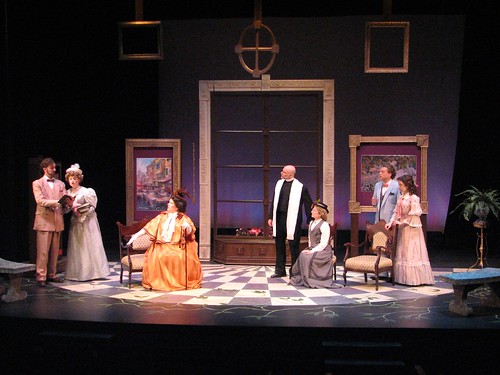
The Importance of Being Earnest ****
Basically, literature has a lot to answer for. Maybe they want to describe what it’s like, and showcase what life is for women, but I think what is nice about novels is that they describe the way it should be.
And guys should not be the only ones who get to screw up big time in literature.
What do you think? Do women receive enough attention in literature? Or, do you have any examples to show that there's a better side of literature I haven't found yet?