Showing posts with label Movies. Show all posts

Thursday, March 19, 2015

Play

03

Remote Control
Flickr Credit: Thunderchild7


Harry, a sleepy-faced eight year old, sits on the couch watching movies; he has been there for six hours and his eyes are starting to glaze over. There is an overturned bowl of Captain Crunch on the floor, and he is eating it straight from the box. The remote control sits on the stand beside him.

His persistent six year old sister, Kara, enters.

Kara: Harry, Harry, come look! I made a castle!

Harry grunts and keeps his eyes fixed on the screen. Kara runs to him and starts to pull the cereal box from his hand.

Kara: Come and play with me, please? Please?

Harry: Go away!

He settles back onto the couch, and laughs at something onscreen. Cereal flies from his mouth and sticks to the screen. Kara frowns, and reaches for the remote control. She hits pause.

Harry: HEY! I was watching that!

Kara folds her arms, hugging the remote control to her stomach.

Kara: Come play castle with me, first. You haven’t been outside all day.

Harry: I don’t want to go outside. I want to stay in here. And I don’t want to play with you.

He lunges at Kara, who darts out of his reach. The remote is sticky and does not fall from her t-shirt. 

Harry: Kara, I mean it! I’ll tell Mom!

Kara sniffles.

Kara: Just for a few minutes? Please? I won’t even make you be my prince. I just want to show you my castle.

Harry hesitates, then runs for the remote and grabs it.

Harry: Get out. Playing is for little kids—I don’t need castles anymore.

Kara walks out with her head hanging. Harry hits “play” on the remote; his film resumes. 


Tuesday, February 17, 2015

The League of Gentlemen: A Disappointment

Sometimes I wish there were real, classy villains.

James Bond villains. Classy villains. Delicious men with such twisted idealism and beautiful plotting that you can’t help but fall into their gushing grins and want to be evil, too.

(On an unrelated note, I am wary of getting married because inevitably I only fall in love with people of questionable moral fiber, and I don’t want to spend the rest of my life in prison.)

There’s a scene in the episode “Engagement” in the second season of the show The Vicar of Dibley, wherein the Vicar invites Hugo to tea with her. She assumes he’s wondering why she’s asked him over, but to her surprise, he claims he’s figured it out.

You know the film League of Gentlemen, where they gather together the seven master criminals of the world, each of them skilled in their own particular trade—master of disguise, master lock-breaker, explosives expert, etcetera—are all assembled to pull off the greatest robbery of all time. I assume it’s that; am I right?”

He isn’t.

But, I did get the film to watch with my father—this old black and white film from the sixties that I had to borrow from another library system—just to see what Hugo is talking about.

via hypnogoria.com
Fair enough, men who have all been slighted in one way or another by the government/military gather together, all hoping to steal enough cash to embarrass their enemies and live comfortably on an island somewhere until they die.

It was an okay movie, I suppose (obviously, I have to make allowances for the film quality and choices, simply due to the era in which it was filmed), but the story frustrated me. Because these were not classy, dazzling men. They were miffed military men in suits and with petty crimes on their hands.

They ran everything like a polite military operation, secret and dirty and secluded in a day and age before security cameras and annoying neighbors could easily rat them out. Sure, they wore the right clothes, but the silkiness of an Alpha was completely absent.

What was worse, spoiler alert, in the end, they all get arrested because a little boy noticed the faulty plates on their getaway truck. He turned them in to the police and they tracked down the owners.

That made me mad—oh, why did they have to lose? Dad looked at me mildly amused, and reminded me that this was the sixties, and in the end the government and goodness had to win.

Which I thought was stupid.

Granted, I have a sense of morality (somewhere…) and I do tend to have faith in my government, and in the people around me to do the right thing at the right time. Murder is wrong, being mildly rude to someone isn’t particularly acceptable, and I go to church.

All that kind of goes away as soon as I enter a fictional novel.

Books broaden perspectives, change the fabric of morality, philosophy, and science simply as the author sees fit. Gods can be created and destroyed, beauty designed and ugliness tempered. Murder becomes a goal, death is desire, blood is a must and it glitters like rubies on the floor. I expect to breathe in the injustice from the pages and absorb it and breathe it out like smoke.

I wanted them to win… Obviously, this league of gentlemen wasn’t perfect and in fact, with a couple of tweaks to the storyline, I could have easily foiled their plan from the comfort of my own living room.

But I wanted them to win, because they were still the heroes. Their evil was the good. And they disappointed me.

Sometimes I wish villains were real. Not because I don’t have a sense of morality, or because I think that their fundamental actions and beliefs are justified. Sometimes I simply wish that there were people like that—classy, with shiny shoes and tailored suits, neatly combed hair, secret lairs, massive danger, and ultimate calm. People who can do their evil right.

Of course, I should be careful what I wish for. Getting kidnapped by terrorists would probably be just as educational, but I doubt I’d enjoy it at all.

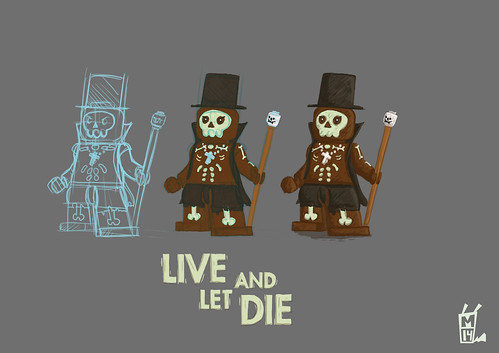
Baron Samedi
Flickr Credit: Julien CARTRY
And yet… Kananga, Nero, Rugen, the Darkling, Thorne, the list goes on and on. No matter how much you root for justice, you also have to root for these guys, because they are fantastic.

Take that, my poor league of gentlemen. You deserved what you got.

Thursday, January 15, 2015

The Glow from the Silver Screen

Hello, dear Reader. Before we begin my semi-monthly essay on Life, the Universe, and Everything, I'd like you to go over to this link (opens in a different tab) and listen to this song. It's about 11 minutes, but it helps you better understand the topic I will discuss. You don't have to listen, but you should. It probably won't make sense, but after this post it will.

*     *     *

Last year (by that I mean my sophomore year), I became obsessed with what the genre-ists refer to as noir fiction. The "hard-boiled", crime detective novels from the 1930s, classic movies from Hollywood's Golden Era, with tough-talkin' detectives with trench coats and square jaws, like Humphrey Bogart and Peter Lorre!

Crime noir is a weird genre. The dialogue is very different than what you might expect. It's very sparse, like Hemingway, but it's vivid, lurid and lusty (as lusty as 1930s standards can get you. It's all good, though.) Consider the first sentences from my favorite noir novel, The Thin Man:

"I was leaning against the bar in a speakeasy on Fifty-second street, waiting for Nora to finish her Christmas shopping, when a girl got up from the table where she had been sitting with three other people and came over to me. She was small and blonde, and whether you looked at her face or her body in powder-blue sports clothes, the result was satisfactory. "Aren't you Nick Charles?" she asked.
I said: "Yes".
She held out her hand. "Dorothy Wynant. You don't remember me, but you ought to remember my father Clyde Wynant. You-"

Reading crime fiction, especially by the two masters of the genre, Raymond Chandler (who's best known for The Big Sleep and his Phil Marlowe stories) and Dashiell Hammett (who wrote the above novel, The Thin Man, and perhaps the most evocative of them all: The Maltese Falcon.) Everyone knows about these two, and people usually enjoy Chandler's stories more. But I'm a Hammett fan and I always will be. Chandler portrays the pointlessness of it all, the hard rugged life, and Hammett does too, but he makes it more witty and glamorous. Not too much, though. But The Thin Man, for example, has characters going in and out of speakeasies faster than you can turn the page.

Hammett does a good job of recreating the stereotypes and fantasies we have of the era. You watch Casablanca, The Maltese Falcon, His Girl Friday, all these great classic Golden-Age films with the greats: Douglas Fairbanks, Clark Gable, Maureen O'Sullivan, Lauren Bacall (who just died last year), Ingrid Bergman...If you're like me, you want to enter the fantasy. You want to become a Prohibition era detective, like Hammett's "blond satan" Sam Spade, who's always digging for the truth, if you'll pardon the pun, or or a sweet dame who's in a spot of trouble but turns out to be a traitorous beauty, like Brigid O'Shaughnessy.

*     *     *

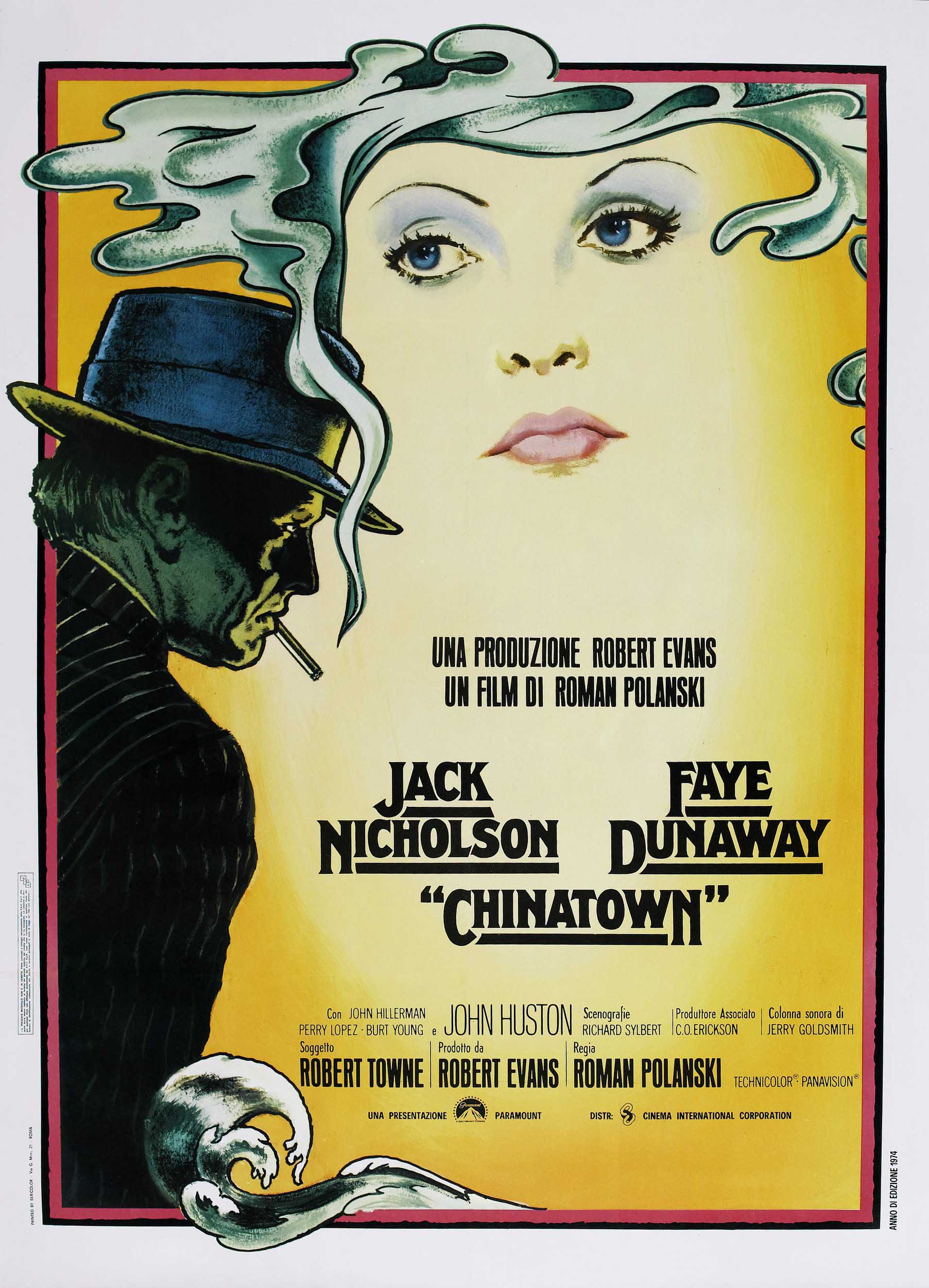
The film poster to the right looks like something from the '30s, am I right? Nope. The movie was made in 1974. It is perhaps one of my favorite movies, not just about gangsters and detectives, but of all time. I mentioned before how I really didn't focus on the pointlessness and despair of crime noir, but Chinatown does an excellent job of showing it to people. The life of Detective Gittes is hard, from tracking down murderers to dealing with dead people and an unstable woman. In the end, nothing matters: justice can never be served but with blood and revenge. "Forget it, Jake. It's Chinatown."
 
The point is this: crime noir gets to show us two sides of an era: the glitzy, svelte allure of speakeasies and Humphrey Bogart, and the harsh, rough and tumble lifestyle of Jack Nicholson getting his nose slashed up.
 
Overall, crime noir is a good genre if you enjoy history and classic movies, and gangsters, and trench coats. As I said before, it's a hard genre to get into. There's codes and jargon for everything. It was a hard life to live back then, and sparse dialogue and snappy comebacks are a result of that. (As was heavy drinking and excessive smoking, but that's neither here nor there.) XD
 
*     *     *
 
The song I had you listen to was full of sound clips from The Maltese Falcon, starring Humphrey Bogart. There were numerous other references to silent-era films and Golden Age greats. Yes, it may have seemed odd and confusing. The song is a good one, though, especially the ending: the ending shows how movies are powerful. If you've seen Hugo Cabret, you know this: the fantasies and delusions of actors on the silver screen are inspiring. We go to the movies for release, to see characters who may be like ourselves, or ones who live completely different lives than our own. We go to the movies to indulge our curiosity, to experience the thrill of seeing scenes that make us go "What if?" What if we met our lifetime love on the Titanic? What if we were all connected to a computer matrix mainframe? What if we were silent-era movie actors who were replaced by the "talkies"?
 
Movies are amazing things. They really are. Like books, they can show us so much more than what we know, take us to worlds afar. This is what is so amazing about media.
 
Fantasy would fill my life, and I love fantasy so much...
 
-R.R.


Tuesday, November 11, 2014

Surprize & Discovery in 1807 England

Today's topic was inspired by two truly marvelous stories: Susanna Clarke's Jonathan Strange & Mr Norrelland the 2003 movie Master and Commander: The Far Side of the WorldBoth are set in roughly the same era: the latter in 1805 and the former begins in 1807. All three deal with England during the Napoleonic Wars (hence the title).

England during this time was in the middle of a very feisty and contentious war with France. It was also an exciting time in History: there was America's Ograbme, impressments, Ali Pasha taking over Egypt, the international slave trade ending...It was definitely a time of great change, excitement, surprize (I use the archaic spelling) and, of course, most importantly - discovery.

Russell Crowe as Captain "Lucky" Jack Aubrey.
Photo Credit: weebly.com
For the unaware, Master and Commander is, put quite simply, the story of a British ship, the Surprize, trying to destroy its French enemy, the Acheron. But it is so much more than that! It is a wonderful movie, especially if you appreciate the time period and context in which it takes place. There is no Jane Austen and her Mr. Darcy here - rather, a rough, but playful, exciting, but sobering account of war and discovery on the high seas.

Jonathan Strange & Mr Norrell, on the other hand, is slightly different. By slightly, I mean alternate-history slightly. In an alternate England, magic was alive and well until the 1600s - when the Raven King and the Aureate magicians disappeared. Everyone knew the history of magic - but none knew how to conjure it - until Mr Norrell, and later, his wayward disciple, Jonathan Strange come along during the Napoleonic Wars, and bring magic back to Britain.

Both of these have a main element of discovery among them - but also showcase its effects quite well: the benefits, the joy, and the dangers resulting from curiosity.

*      *       *
Discovery, of any kind, is always exciting and slightly shocking, by definition. To look upon or learn something that was never seen or known before is humbling, and yet there is a certain thrill about it. From discovering a new element, to naming a new species, to reading a previously unknown letter by someone famous, to unearthing a new artefact, to proving a new theorem - all provide a great sense of either hope or terror. Because, for every cure for polio or smallpox, there was also the discovery of Ebola and how to create an atomic bomb. For every discovery of America, there was also a great genocide and mass murder of countless innocent people. For as humans, we have been entrusted with the greatest gift of all: curiosity. But as humans, we also have a sadly notorious proclivity for using that curiosity for horrifying things. Keep this in mind.

*      *      *
Mr. Norrell, the
greatest magician of the Age.
Photo Credit: fantasybookreview.co.uk
In Jonathan Strange & Mr Norrell, the peaceful naivete of Mr Norrell and Jonathan Strange, bravely trying to use Magic for good, is upturned when Strange is interested in the darker, more dangerous arts, and tries to use magic for these. For me, this is like to nuclear power. The possibilities of nuclear power, when first discovered, are endless, and amazing - virtually limitless power from a few radioactive metals and fission! But then came the atomic bomb. Chernobyl. Three Mile Island. Today, we live in a nuclear age. The days when schoolchildren were taught how to hide from an A-bomb are thankfully gone, but the spectre of attack still lies heavy over our heads. Such is human nature. But don't think I'm entirely cynical...

*      *      *
One of the most telling scenes in Master and Commander takes place when the Surprise first arrives at the Galapagos Islands, between young Lord Blakeney and Dr. Maturin:

Maturin: Here's an insect that's taken on the shape of a thorn to save itself from the birds.
Blakeney: Did God make them change?   
Maturin: Does God make them change? Yes, certainly. But do they also change themselves?  Now that is a question, isn't it?


There is a perfect reconciliation of science and faith here. Often these two are at bitter odds - which is correct? Which explains Life, the Universe, and Everything? As for me, I maintain that they are two different ways to explain the same thing - for me, God is equivalent to the Universe, Creation is the Big Bang, science is equal to faith, and a rosary is equivalent to a microscope. They are all one and the same.

*      *      *
Mr Norrell is a most secretive person. He is narcissistic, in a way - he wants to be known as the only magician in England, and while he and Jonathan Strange become good friends, they eventually become opposing magicians. This is partly due to Mr Norrell himself - the old "hero creates his enemy" prophecy-trope.
You see, Mr Norrell owns every single book of magic in England. When magic was unknown he was able to purchase every one rather quietly and on the down-low, but when magic became respectable and fashionable, everyone was on the lookout. However, Mr Norrell was able to get to every single one - spending up to 2100 guineas on one rare book. He did this to hide information - in short, to ensure he was in control of knowledge. (Shades of 1984 here...) This is partly why Jonathan Strange went his own way, away from Mr Norrell - unable to read the great books of magic which Norrell hid, he felt there was more to knowledge and set out to discover more. Strange is in the right here, partly. To me, Norrell represents the old, traditional order - trying to keep stability and a semblance of right and wrong which has stayed in place for centuries. But Strange is the young discoverer - the pioneer, as it were. He represents discovery, science, and progress. He is to bring the world forward in terms of Magic - but, of course, there are many dangers in wait for him. (Does he succeed? Well...you'll have to read the novel to find out.)

*      *      *
Part of the main plot of Master and Commander is the promise Captain Aubrey makes to Dr. Maturin - to spend time to explore the Galapagos Islands and make naturalistic discoveries, particularly that of a flightless cormorant. However, Maturin's hopes are dashed three times - all due to the Acheron being nearby. At one point, Aubrey is all set to sail away and capture the Acheron, but Maturin wants to stay behind, studying all the new animals.
To discover new species! It must be so exciting and tremendous, the act of being the first human to look upon a certain animal, or at least to name it and study its evolutionary traits. Maturin surely felt this way, and I'm sure the other great naturalists - Darwin on the Beagle, Linnaeus and his taxonomic organization - felt this way. However, again - progress and stability clash again when Maturin petitions Aubrey to stay behind.
Dr. Maturin: Jack, have you forgotten your promise?
Capt. Aubrey: Subject to the requirements of the service. I cannot delay for the sake of an iguana or a giant peccary. Fascinating, no doubt, but of no immediate application.
Dr. Maturin: There is, I think, an opportunity here to serve both our purposes...I could make discoveries that could advance our knowledge of natural history.
Capt. Aubrey: If wind and tide had been against us, I should have said yes. They're not. I'm obliged to say no.
Dr. Maturin: Oh, I see. So after all this time in your service, I must simply content myself to...hurry past wonders, bent on destruction. I say nothing of the corruption of power...
Paul Bettany and Russell Crowe as
Dr. Stephen Maturin and Captain Aubrey.
Photo Credit: weebly.com
Capt. Aubrey: You forget yourself, Doctor.
Dr. Maturin: No, Jack, no. You've forgotten yourself. For my part, I look upon a promise as binding. The promise was conditional.
Capt. Aubrey: We do not have time for your damned hobbies, sir!
Bear in mind, Aubrey and Maturin are friends. However, sadly, this is what happens when progress and stability - the stability of the Empire - takes place. I might be reading too much into this, but in a way it's the same argument betwixt Jonathan Strange and Mr Norrell.

*      *      *
I hope you'll apologize for the strange way this blogpost was written - a series of vignettes, all slightly disconnected, is hardly the best way to go about writing. It's a bad habit I have gotten in. But I hope this was helpful. If anything, it's a polemic on human nature & discovery - and the outcomes they create when combined. Dwell on that, won't you?

Khodafez.
-R.R.